Structured proposals. Transparent voting.
When it's time to decide, everyone sees the same options, casts their vote, or delegates to someone they trust. Fair, private where it matters, and impossible to hand-wave the outcome.
Fair outcomes come from a fair process
When a decision feels rushed, one-sided, or made by whoever showed up that day, members lose trust in the outcome, even when the outcome is right. FluidForum turns voting into something the whole group can stand behind: proposals with full context, secure ballots, and delegation for members who'd rather trust an expert than skip the round entirely.
Everyone casts, everyone counts, everyone can verify
Four capabilities make sure the vote reflects the whole group, not just the members who happened to be online at the right hour.
Structured proposals
Every proposal carries the discussion history that shaped it. Voters see the trade-offs, the objections, and the reasoning, not just a title and a yes/no button.
Secure, tamper-proof voting
One member, one vote, verified. Ballots are locked until the deadline to prevent bandwagon effects, and results are cryptographically counted for a fraud-free tally.
Delegated voting
Can't make a call? Pass your vote to someone whose judgment you trust, either transparently or anonymously. Members get notified when a delegated vote is used on their behalf.
Batch voting rounds
Members vote on all open proposals at the end of a round, not one at a time. Less voter fatigue, more considered decisions, and no proposal gets buried at the bottom of a queue.
Members show up prepared, or hand off to someone who did
The best voting systems don't ask every member to be an expert on every topic. They give people the context to vote well when they can, and a trusted way to hand off when they can't. FluidForum does both, with transparency where it matters and privacy where it should be.
- Every vote comes with the full discussion history for context
- Delegate to a trusted member when a topic is outside your expertise
- Choose anonymous or transparent voting per proposal
- Results stay locked until the deadline, no bandwagon effect
- Every delegation is auditable, so transparency stays where it matters
How it works
From ideas to action in five simple steps
Replace endless discussions and delayed decisions with FluidForum, the platform designed to make collective action faster and smarter.
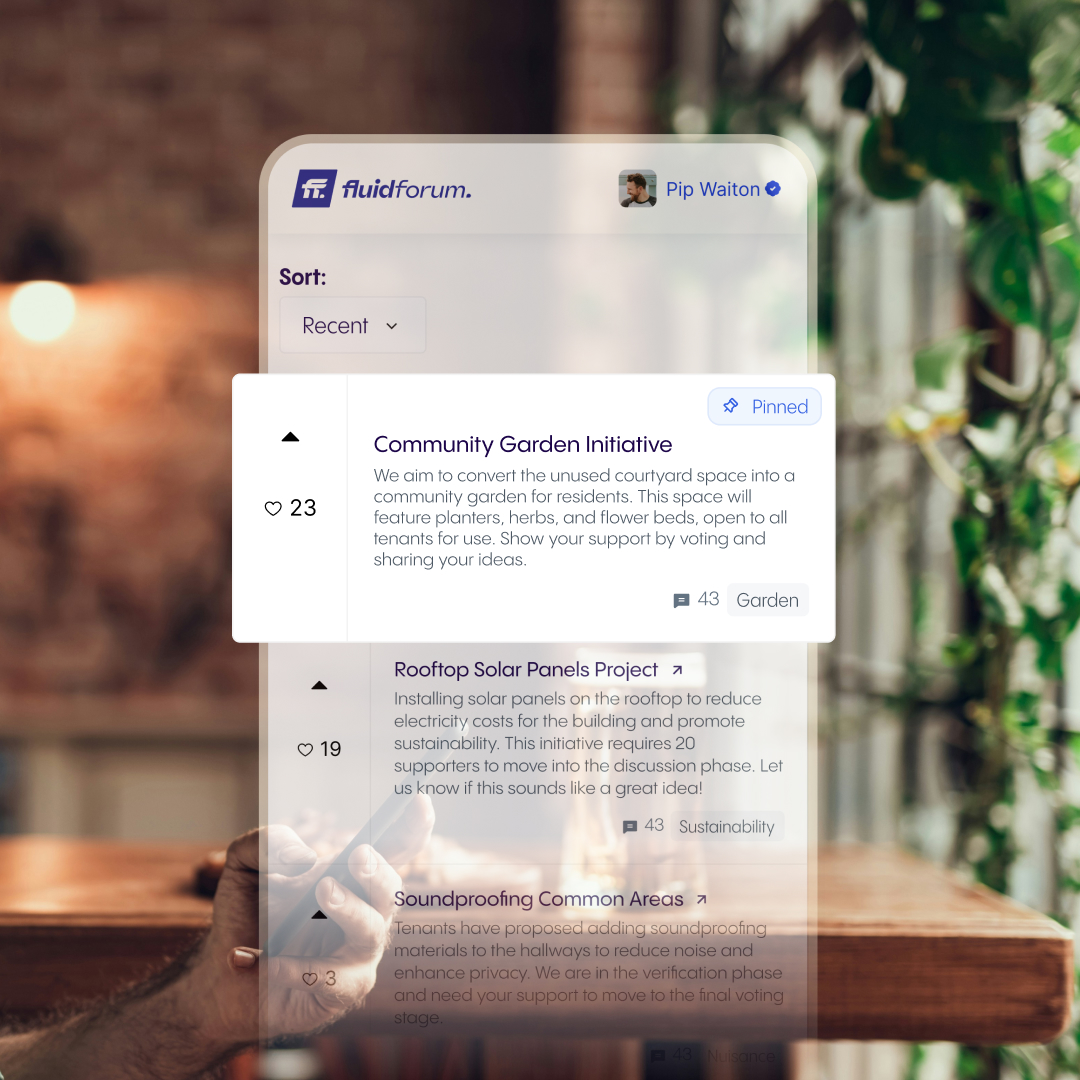
- 1
Submit an idea
Any member can share an idea. Whether it's about organizing an event, improving facilities, or shaping policy. Ideas are structured with a title, description, and optional attachments for clarity. Other members can view and engage with ideas in real time.
- 2
Discuss & improve
Members can comment, suggest improvements, and like ideas to show support. Ideas remain in the discussion phase for a set time, giving everyone a chance to contribute. Discussion threads keep feedback structured and easy to follow.
- 3
Ideas that gain support become proposals
Once an idea reaches the support threshold, it moves to the proposal phase for a final vote. All members cast their votes digitally, making participation easy. The system ensures secure, fraud-free voting with clear results.
- 4
Delegate votes for better representation
Members who can't participate in voting can delegate their vote to a representative they trust. Delegations can be transparent or anonymous, depending on preference. Users receive notifications when a delegated vote is used.
- 5
Turn decisions into action
Approved proposals move forward for implementation. Admins and decision-makers receive alerts on next steps. A historical record of all votes, discussions, and approvals is stored in the archive for accountability.
How proposals and voting actually work
Answers on ballot security, changing your mind, quorum, and mixing anonymous with open votes.
Ballots stay locked until the deadline, so nobody, including FluidForum staff, can see running tallies mid-round. Each ballot is bound to one member account, and account creation is controlled by your group admins, so one person cannot stack votes with duplicate accounts. When the deadline hits, ballots open and results calculate automatically. You can verify the totals by re-tallying the archived ballot log yourself: every ballot is listed with its proposal, timestamp, and (for open votes) the voter.
Yes. Until the deadline, your ballot and any delegations you have made are editable. Change your vote, swap your choice, revoke your delegation, or hand it to someone else. Once the deadline passes, ballots close, delegations freeze, and the result is written to the archive. That is the point of batch voting at the end of the round: you get time to read, discuss, and reconsider before anything is final.
You set the quorum yourself when you configure the group. If a proposal doesn't hit quorum, it doesn't pass, even if the yes votes outnumber the no votes. The proposal and its full discussion stay in the archive with the outcome recorded. You can resubmit it as a new proposal, optionally revised, and run it again.
Yes. Anonymity is set per proposal, not per round. Sensitive topics like electing a board member or resolving a conflict can be anonymous, while budget decisions or day-to-day matters stay open. Delegations follow the same rule: transparent by default, anonymous when the proposal calls for it. On anonymous proposals, delegates cast the pooled vote without seeing who delegated to them.
Decisions made easy, ideas made real.
Start your first idea round in minutes.